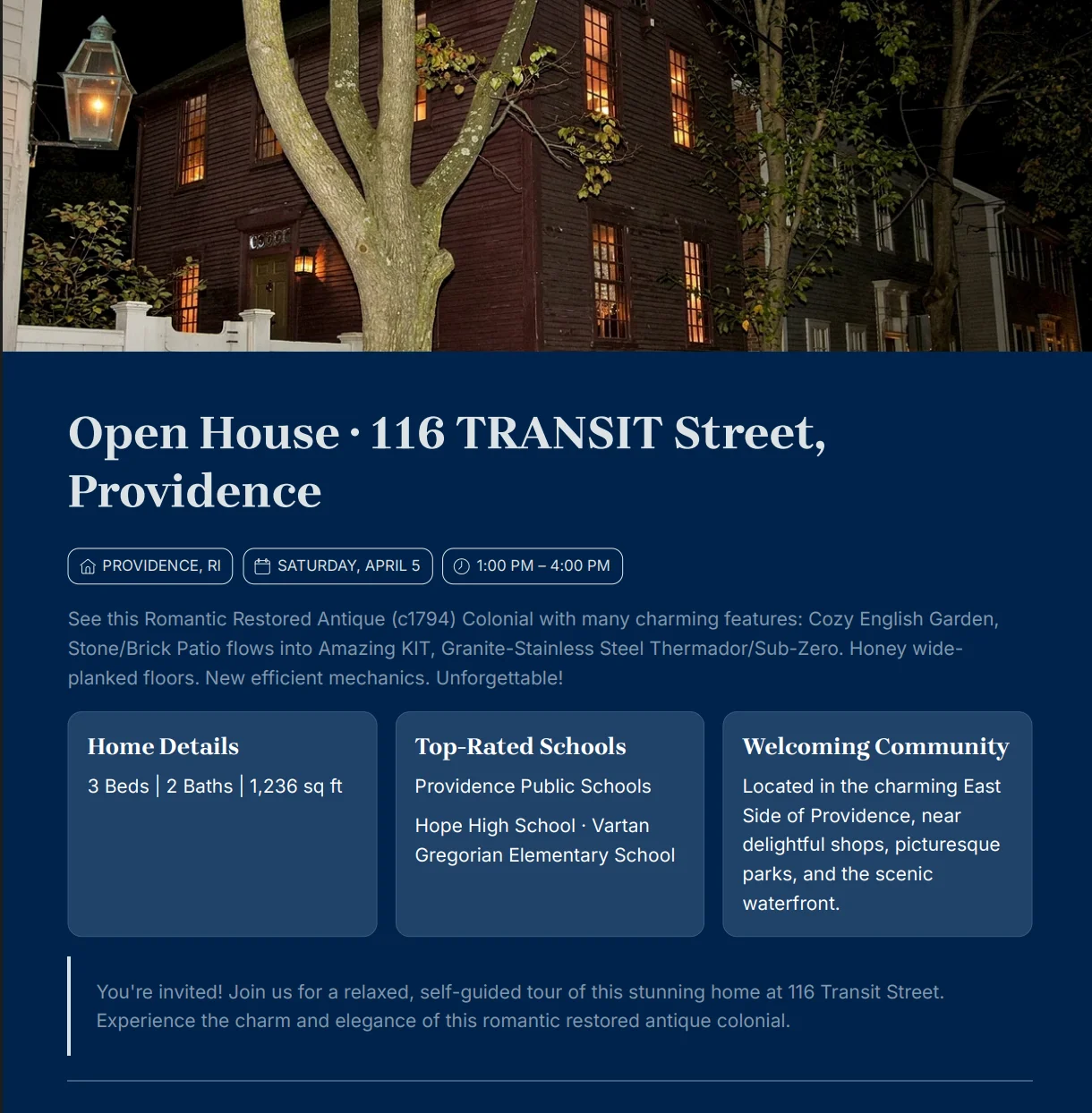


Every agent has seen the newsletter that gets deleted on sight: national mortgage-rate headlines, a pumpkin-spice recipe, a "fall maintenance checklist" scraped from somewhere, and a giant headshot. It technically counts as "staying in touch." It builds nothing.
And yet the newsletter is still one of the highest-leverage marketing habits in real estate — because the database you already have is where your next listings live, and most sellers list with the first agent they think of, not the best agent they interview. The entire game is being that first thought, month after month, for years.
This guide covers what actually belongs in a real estate newsletter, the template we recommend, how often to send, examples by audience, and how to produce the whole thing in under an hour a month.
Why Real Estate Newsletters Still Work
- You own the channel. Social reach is rented from an algorithm; your email list is yours. A database of 500 past clients and prospects, emailed monthly, is a pipeline asset no platform change can take away.
- The economics are absurd. Email costs effectively nothing per send. One listing per year from a newsletter pays for a decade of the habit.
- The bar is on the floor. Most agent newsletters are generic filler. A genuinely local, genuinely useful one stands out immediately — this is one of the few marketing channels where being merely good makes you exceptional.
What to Put in a Real Estate Newsletter: The 5-Block Template
Steal this structure. Fixed blocks, new content each month — the structure is what gets production under an hour:
- Local market pulse (the anchor). 3–5 numbers for YOUR area, not the nation: median sale price, days on market, active inventory, sale-to-list ratio — with one sentence of what it means in plain English ("homes are still selling in under three weeks, but buyers have twice the choices they had in spring"). This is the block readers actually forward.
- One useful insight. A single short answer to a question clients actually ask: "Should I sell before I buy?", "What does the new insurance situation mean for closing costs?", "Is a pre-listing inspection worth it?" One question, 150 words, plain language.
- Proof. One recent sale story with numbers ("listed at $612k, 9 offers, closed $41k over"), a client win, or a just-listed/just-sold. Proof is what quietly converts readers into sellers — it shows you are actively doing deals, without saying "hire me".
- One call to action. Exactly one. The evergreen winner: a free home-value check. "Curious what your home is worth in this market? Reply and I will send you a full report this week." A newsletter with three CTAs has zero.
- A personal note (short). Two or three sentences of you — the local restaurant opening, your kid's team, the neighborhood event. This is the block that makes the reply feel natural when they finally need you.
That is the whole template. Subject line: lead with the local number, not your name — "Maple Grove homes: 18 days on market, and what that means for fall" beats "Jane Smith Realty October Update" every single time.
20 Real Estate Newsletter Content Ideas
Rotate through the insight and proof blocks with these — each is one block, not one issue:
- Neighborhood-by-neighborhood price map of your farm area
- "What $500k buys right now" — three current listings compared
- The most over- and under-priced listing you saw this month (anonymized)
- Local development news: the new grocery store, school rezoning, road project — and what it does to values
- Seasonal timing: what listing in January vs. May actually looks like in your market's data
- Anatomy of a recent deal: what almost killed it and how it closed
- Property tax assessment season: how to read (and appeal) yours
- Insurance, HOA fees, rates — the "monthly payment beyond the mortgage" breakdown
- Renovation ROI in your market: what the sold data says actually pays back
- First-time buyer myth of the month
- Rent vs. buy math for your zip code, updated
- The 5 questions to ask before an open house visit
- What a pre-approval actually commits you to (and what it doesn't)
- Local vendor spotlight: the inspector/lender/contractor you actually trust
- "Just sold on your street" — the classic, with real numbers
- Your market vs. the national headlines: why the national story doesn't apply here
- Downsizing checklist for empty nesters (a listing-generation classic)
- What happens at closing, explained like you're smart but new
- Reader Q&A: answer an actual client question from this month
- Year-in-review: your market's 12-month story in five numbers
How Often Should You Send? (Monthly. Here's Why.)
Monthly is the right default. Weekly is a content treadmill that burns out solo agents by issue six, and frequency without substance trains people to delete you. Quarterly is too rare to keep you as the first thought when a life event triggers a move. Monthly is frequent enough to compound, rare enough to keep quality up — and consistency beats frequency: a monthly newsletter sent for three straight years beats a weekly one abandoned in March.
Two audiences justify a different cadence: active buyers (weekly new-listings digest — that is a saved search, not a newsletter) and geographic farms (a quarterly printed market report mailed to the neighborhood pairs well with the monthly email).
Real Estate Newsletter Examples by Audience
- Past clients & sphere (the default list): the full 5-block template. Goal: referrals and the eventual relist. Tone: neighborly expert.
- Geographic farm: heavier on the hyper-local market pulse and just-sold proof; the CTA is always the home-value check. This is the email version of geographic farming.
- Homeowner/seller prospects: equity-focused — what their home is worth, what improvements pay back, when to time a sale.
- Investor contacts: cap rates, rent trends, off-market chatter — shorter, number-dense, no personal note needed.
Do not build four newsletters on day one. Start with one list and the 5-block template; split audiences only when the single version starts feeling generic.
Producing It in Under an Hour (the Data Is the Hard Part)
The template makes writing fast; the bottleneck is pulling the local numbers — and that is exactly the part your tooling should do. On RealAnalytica, the market analytics that power CMAs give you the median price, days-on-market, and inventory numbers for your exact area, and the Atlas assistant can draft the market-pulse block from them in plain English — you edit for voice, add the personal note, and send. Pair it with the CRM's email sequences and Keep-in-Touch reminders and the follow-up on every "what's my home worth?" reply is handled instead of forgotten.
Whatever stack you use, the production rule is the same: fix the structure, batch the data pull, write the two human blocks fresh. An hour a month, compounding for years.
The Metrics That Matter
Opens are vanity (and Apple's privacy features inflate them anyway). Watch instead: replies (the whole point), home-value/CMA requests (listing pipeline), unsubscribe rate (above ~0.5% per send means the content drifted generic), and — the one that pays — listing appointments that mention the newsletter. A newsletter generating two real conversations a month is outperforming one with a 40% open rate and silence.
The Bottom Line
A real estate newsletter is a compounding asset disguised as a chore. Local numbers, one useful answer, one piece of proof, one CTA, one human note — monthly, forever. The agents who win with newsletters are not better writers; they are the ones still sending in year three, when the reader's lease ends or the second kid arrives and the first agent they think of is the one who never stopped showing up in their inbox.
If pulling the local data is what's stopping you, RealAnalytica starts free — market analytics, CRM, and an AI assistant that drafts the market pulse for you.
Frequently Asked Questions
What should be in a real estate newsletter?
Five blocks: a local market pulse (3–5 numbers for your specific area with a plain-English takeaway), one useful insight answering a question clients actually ask, one piece of proof (a recent sale story or client win with real numbers), exactly one call to action (a free home-value check is the evergreen winner), and a short personal note. Skip national headlines and generic filler — local and useful is what gets opened.
How often should a realtor send a newsletter?
Monthly. Weekly is a content treadmill most solo agents abandon within two months, and quarterly is too infrequent to keep you top of mind when a life event triggers a move. Consistency matters more than frequency — a monthly newsletter maintained for years beats a weekly one abandoned in March. The exceptions: active buyers can get a weekly listings digest (that is a saved search, not a newsletter), and geographic farms pair well with a quarterly printed market report.
Do real estate newsletters actually work?
Yes — because most sellers list with the first agent they think of, not the best one they interview, and a monthly newsletter is the cheapest way to be that first thought across your whole database. The channel is owned (no algorithm), the cost per send is effectively zero, and one listing a year from it pays for a decade of the habit. The catch: it works on a 1–3 year horizon, which is exactly why so few agents stick with it long enough to see it.
What is a good subject line for a real estate newsletter?
Lead with the local number, not your name: "Maple Grove homes: 18 days on market, and what that means for fall" beats "Jane Smith Realty October Update". Specific local data signals the email contains something useful about the reader's own biggest asset — that is the open trigger. Keep it under about 55 characters so it survives mobile truncation.
Are there free real estate newsletter templates?
The 5-block structure in this guide is the template: local market pulse, one insight, one proof story, one call to action, one personal note — copy it into any email tool. Most CRM and email platforms (including RealAnalytica's email sequences) provide the layout side. The scarce ingredient is not the design template; it is the local market data that fills block one, which is where an analytics-connected tool saves the most time.