
A real estate team is one lead agent plus people who take work off their plate. Built well, a team lets you help more clients without working more hours. Built badly, it means you make less money and spend your week managing people.
This guide walks through how to build a real estate team step by step: how to tell if you are ready, the common team structures and roles, how splits usually work, who to hire first, and the systems to set up before anyone new starts.
When Should You Build a Real Estate Team?
There is no magic number of closings. Some agents start a team at a pace others handle alone. Look for these signs instead:
- You are losing business because you are too busy. Leads wait days for a call back. You say no to buyers because your calendar is full. Past clients refer friends, and you cannot get to them.
- Much of your week goes to work that does not need your license. Paperwork, scheduling, data entry, and chasing signatures.
- You have a lead source beyond your own network. A team needs leads to feed its agents. If every deal comes from your personal network, adding a buyer's agent means splitting deals you would have closed anyway.
- It has lasted for months. One busy spring is not a reason to hire. A steady overflow is.
There is one more question, and only you can answer it: do you want to manage people? Running a team means hiring, training, coaching, and sometimes letting someone go. Some great agents are happier staying solo with good help and good tools.
A quick way to check the money: add up the hours you spend each week on tasks someone else could do. Then ask what you would earn if you spent those hours on listing appointments and client calls. If that number is bigger than what the help would cost, a first hire makes sense. Our real estate business plan guide walks through this kind of goal math.
Real Estate Team Structure: The Common Roles
Most teams are built from the same set of roles. Small teams have one person covering several of them. Bigger teams split them out.
| Role | What they do | How they are often paid |
|---|---|---|
| Team lead (the rainmaker) | Brings in business, takes listing appointments, sets the standards, coaches the team | Their own deals plus a share of team deals |
| Admin or operations assistant | Calendar, CRM cleanup, listing setup, marketing orders, vendor scheduling | Hourly or salary |
| Transaction coordinator (TC) | Runs the deal from signed contract to closing: deadlines, documents, and updates to everyone involved | Per file or salary |
| Buyer's agent | Works buyer leads, shows homes, writes offers, and guides buyers to closing | Commission split with the team |
| Inside sales agent (ISA) | Calls and texts new leads fast, asks the first questions, and sets appointments for the agents | Base pay plus a bonus per appointment or closing |
| Showing assistant | A licensed agent who covers showings and open houses when the main agent cannot | Flat fee per showing |
| Listing specialist or marketing coordinator | On larger teams: listing prep, photos, marketing, and seller updates | Salary, split, or both |
Some of these jobs need a real estate license and some do not. What an unlicensed assistant may do differs by state, so check your state's rules before you hand off anything that involves talking to clients about a deal. For a closer look at the TC role, see our guide to what a real estate transaction coordinator does and what one costs.
Common team models
- Lead agent plus help. One producing agent, one admin or TC, and one or two buyer's agents. This is where most teams start and where many stay.
- Rainmaker model. The team lead brings in most of the business through their brand, ads, or sphere, and the team works it. It depends on the team lead's lead flow.
- Partnership. Two agents share costs, staff, and sometimes income. It works best with a written agreement on who does what and how money is split.
- Larger teams. Several lead agents or offices under one team brand, with shared operations staff. These run more like a small company and need more management.
How Real Estate Team Splits Work
Every team sets its own splits, and your brokerage's rules come first. Still, most team comp plans follow one simple idea: the more the team provides, the bigger the team's share.
- Team leads vs your own leads. Buyer's agents usually get a smaller split on leads the team hands them, and a bigger one on leads they find themselves. Many teams start near an even split on team leads and adjust from there.
- Brokerage split first. Your brokerage's split and fees usually come off the top before the team split. Run the math on what is left, or you may find a deal pays the team less than you thought.
- Staff pay. Admins and TCs are usually paid hourly, by salary, or per file. ISAs often get base pay plus a bonus for each appointment that shows up or each deal that closes.
- Payments go through the brokerage. In most states, commissions are paid to the brokerage, which then pays the agents. Check your state's rules and your brokerage's team policy.
Whatever you choose, write it down. A team agreement should cover splits, who owns a lead, what happens to leads and deals in progress if someone leaves, expenses, and what the team expects from each person. Have your broker review it before anyone signs.
Who to Hire First on a Real Estate Team
A good rule: hire for the problem you have now, not for a team chart you saw online. For most agents, the order looks like this.
- Admin or transaction coordinator. Paperwork and contract-to-close work eat the most hours for most solo agents. Hand those off first, and you get time back for listing appointments and clients.
- Buyer's agent. Once you have more buyer leads than you can serve well, bring on a buyer's agent. Many team leads keep the listings and pass buyers to the team.
- Inside sales agent. When new leads wait too long for a first call, an ISA calls and texts them fast and books appointments for the agents.
- Showing assistant. When showings fill your agents' days, a licensed showing assistant paid per showing can take the overflow.
- More agents, then specialists. Add a second buyer's agent, a listing specialist, or a marketing coordinator only when the numbers show you need them.
Hire slowly. A bad fit costs you leads, clients, and your reputation. Look for people who follow up, show up on time, and take coaching well. Skills can be taught. Habits are harder.
Systems to Set Up Before You Hire
New people should step into a system. If they have to invent their own, every agent will work leads differently, and you will not be able to tell what is working.
- One shared CRM. Every lead, note, call, and email in one place the whole team can see. If a lead lives only in someone's phone, it leaves when they do. Our guide to the best real estate CRM for teams compares the options.
- Written lead rules. Decide how new leads get assigned. Common choices are taking turns (round robin), by area, by price range, or by who is on call. Write it down so no one argues about it later.
- A follow-up standard. Pick a clear rule, like "every new online lead hears from someone the same day, and within minutes during work hours." Then track whether it happens.
- A follow-up plan. What happens on day one, day three, week two, and every month after for leads who are not ready yet.
- Checklists. One for listing launch, one for contract to close, and one for open houses. Checklists keep quality the same no matter who does the work.
- A weekly scoreboard. New leads, appointments set, showings, contracts, and closings for each person. Review it together once a week.
Where AI Agents Fit When You Build a Team
AI can now handle some of the work that used to be a team's first hires, mainly follow-up and transaction tracking. It does not replace people who show homes, sit at the kitchen table with sellers, or make judgment calls. Used well, it lets your first human hires spend their time with clients.
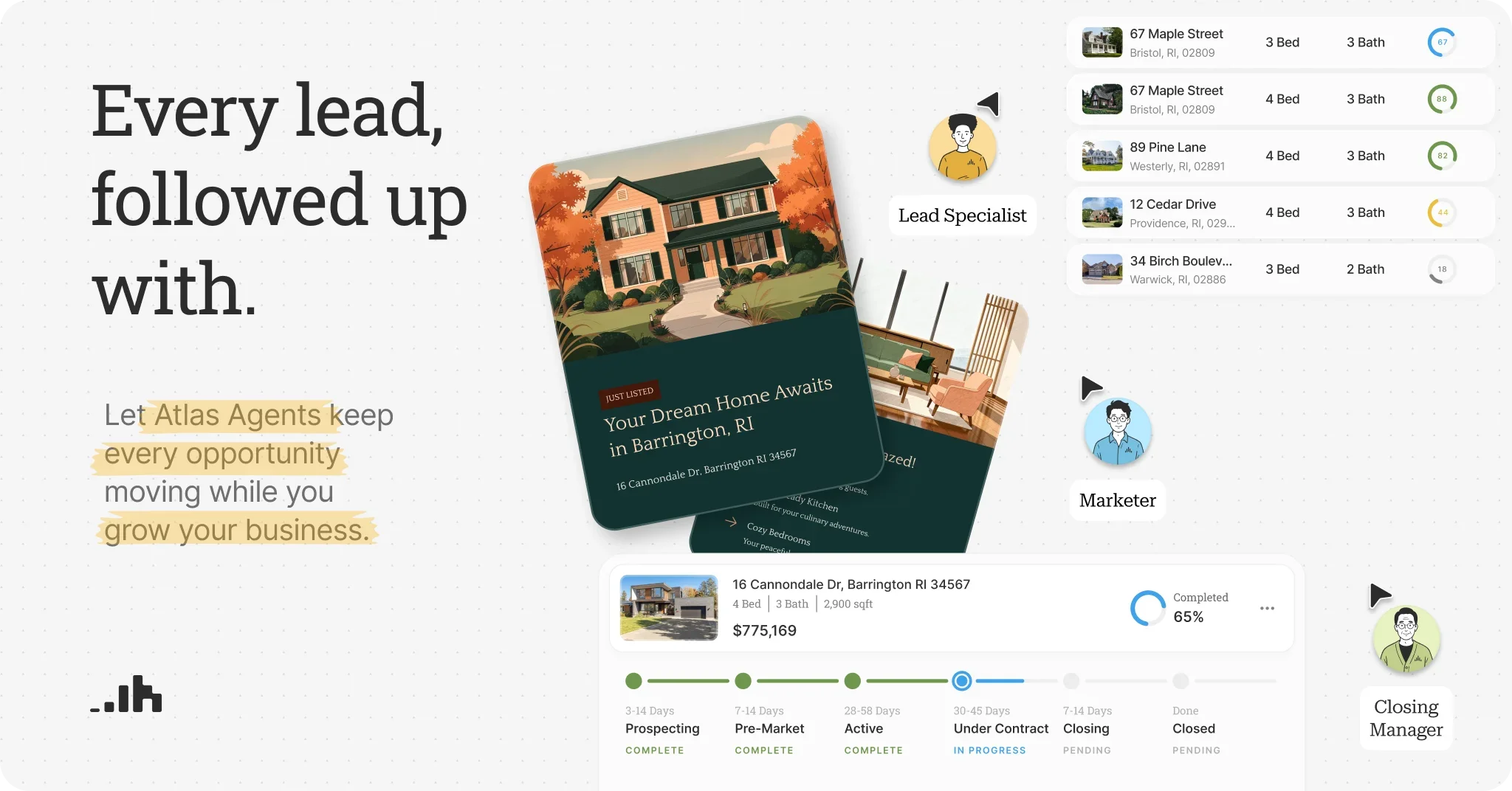
Here is how that works with RealAnalytica's Atlas Agents, a team of AI specialists:
- Lucia, Inside Sales Agent. Every morning, Lucia checks your inbox and CRM for leads that need a touch and drafts the check-ins for your review. That covers much of the day-to-day nurture an ISA would do.
- Ren, Closing Manager. Ren tracks transaction details and drafts the follow-ups that keep a deal moving to closing, which is a big part of a TC's job.
- Scout, Client Manager. Once a week, Scout finds leads that went quiet and drafts personal re-engagement notes, and keeps past clients in touch.
- Miles, Marketer. Ask Miles for flyers, social posts, and listing marketing when you need them.
Every draft, send, and enrollment waits for a person to approve it. The AI does the routine work, and you keep the judgment. For teams, the Teams & Brokerages plan pools Atlas credits across the whole team. If you are not sure whether you need a human TC or software, our guide to the AI transaction coordinator covers the tradeoffs.
A practical path: start with AI covering follow-up and transaction tracking, hire a person for showings and client-facing work first, and add a human ISA or TC when volume or the personal touch calls for it.
Common Mistakes When Building a Real Estate Team
- Hiring agents before you have leads for them. Buyer's agents with nothing to work leave within months.
- Skipping the written agreement. Handshake splits turn into arguments the first time a big deal closes or someone leaves.
- Hiring friends because it is easy. Hire for the role. It is much harder to coach or let go of a friend.
- No tracking. Without a weekly scoreboard, you cannot tell a slow month from a broken follow-up process.
- The team lead stops selling too soon. Your listings and your lead flow pay for the team. Step back from selling only when the team can clearly carry itself.
The Bottom Line
Building a real estate team starts before the first hire. Make sure you have steady overflow and a lead source that can feed other agents. Set up one shared CRM, clear lead rules, and a follow-up standard. Then hire in the order your problems show up: paperwork help first, agents once you have more buyers than you can serve, and specialists after that. Write every split down, track results every week, and let AI take the routine follow-up so your people can spend their time with clients.
RealAnalytica is free to start with Agent Lite. The full data platform starts at $40/user/mo (billed annually), and team plans pool Atlas credits across everyone on the team.
Frequently Asked Questions
How do you build a real estate team?
Start by making sure you have steady overflow and a lead source that can feed other agents. Set up one shared CRM, written lead rules, and a follow-up standard. Hire an admin or transaction coordinator first, then a buyer's agent once you have more buyer leads than you can serve, then an ISA or showing help as volume grows. Put every split in a written team agreement your broker approves, and track results weekly.
When should a real estate agent start a team?
When you have been too busy to serve all your business for months, not weeks, when much of your week goes to work that does not need your license, and when you have a lead source beyond your personal network. There is no set number of closings. It also only makes sense if you want to hire, train, and manage people.
What is the best real estate team structure?
For most agents, the best structure is the simplest one that fixes today's problem: one lead agent, one admin or transaction coordinator, and one or two buyer's agents. Add an inside sales agent, showing assistants, and specialists only when your numbers show a need. Larger teams split roles further, but they need more management.
How do real estate team splits work?
Most teams give agents a smaller split on leads the team provides and a bigger one on leads the agent finds. Your brokerage's split and fees usually come off first, then the team split. Admins and transaction coordinators are often paid hourly, by salary, or per file, and ISAs often get base pay plus a bonus. Every team sets its own numbers, so put them in a written agreement your broker reviews.
Who should be the first hire on a real estate team?
For most agents, an admin or transaction coordinator. Paperwork, scheduling, and contract-to-close work take up the most hours that do not need your license. Handing those off gives you time for listing appointments and clients. Hire a buyer's agent next, once you have more buyer leads than you can serve well.
Do you need a broker's license to start a real estate team?
Often not. In many states, a team works under a sponsoring brokerage, and the team lead holds a regular agent license. But states have different rules for teams, including how teams can advertise and name themselves. Check your state's real estate commission rules and your brokerage's team policy before you start.
Can AI replace an ISA or transaction coordinator?
AI can cover part of both jobs. It can draft daily lead follow-up, find leads that went quiet, and track transaction deadlines and updates. It cannot show homes, build trust face to face, or make judgment calls. RealAnalytica's Atlas Agents, for example, draft this work for a person to approve before anything sends. Many teams use AI for the routine follow-up and hire people for client-facing work.